

Crochet Hooks 101: Everything You Need To Know

Crochet hooks are the one thing that separates crocheters from every other yarn crafter. And, when it comes to learning how to crochet, picking the right hook is crucial.
You may have to experiment with several hooks to find the perfect fit. Use the information in this crochet hook guide to learn which hook may be the best fit for you. This post covers the best crochet hooks for beginners by category, crochet hook anatomy, and nuances in crochet hooks that make them easier or more challenging to use.
This post contains affiliate links that support the content on TLYCBlog.com. All opinions are my own. Find my Privacy & Disclosures Policy here.

CLICK HERE TO PIN THIS POST
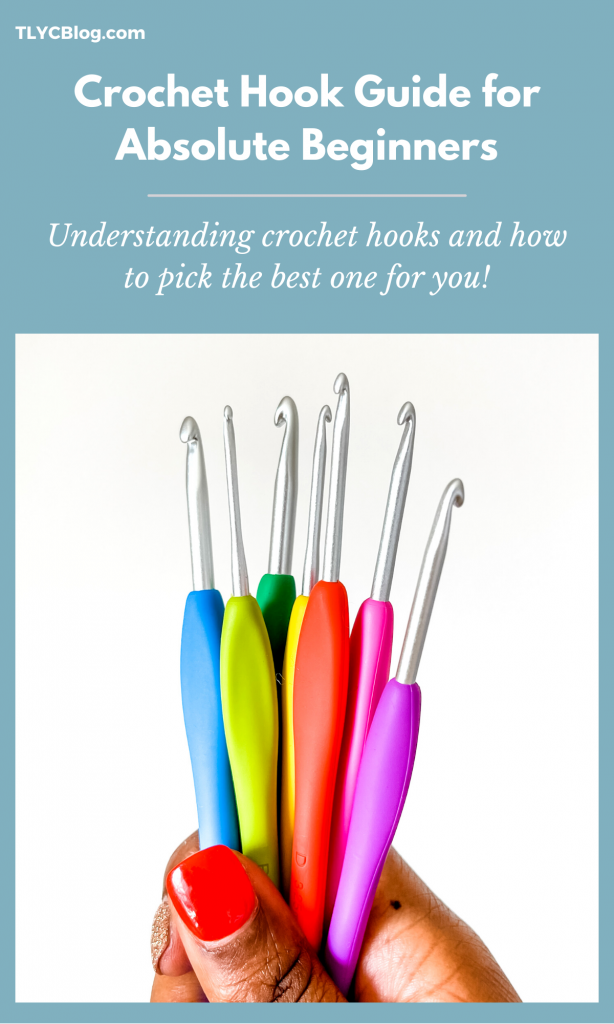
The U.S. market is generous with crochet hook types, offering different shapes, colors, and handles. Changing one feature of a hook can make the difference between a user loving or hating it. As a crochet teacher, I’ve seen a student go from struggling to finally “getting it” just by changing their tools. Here are some tips on picking the right hook for you from the plethora of options available.
NOTE: I am an inline hook user who crochets right-handed, so my opinion is biased. What I consider “best” may not work for everyone. Experiment with different hooks to see what you like.
Best Crochet Hooks by Category
1 // Best Overall Hooks – Clover Amour

Clover Amours are the darlings of the crochet community. Each set (as shown above) comes with 10 hooks ranging in size from 2.25mm to 6mm. The hooks have a matte aluminum finish with comfortable rubber handles. Each handle is a different color with the size marked with the US letter and metric mm on the handle, making it easy to pick the size you need by color or by text. They are a hybrid style, pulling the best features from tapered and inline hooks into one sleek design.
Notable benefits: comfortable for pencil and knife grip, easily accessible in stores and online, smooth shaft makes for speedy crocheting
5/3/2023 – This hook set is for sale on Amazon.com for $41.30 (44% off!). Shop HERE.
2 // Best Inline Hooks – Susan Bates Silvalume
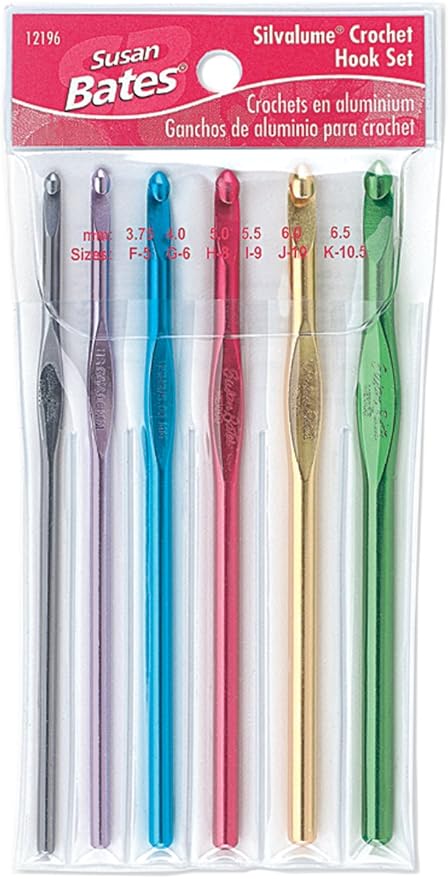
Introduced in the 1960s, Silvalume hooks are what come to mind when someone says they use Susan Bates hooks. Affordable and accessible with sizes ranging from size 2.25mm to 10mm, Silvalume’s are an easy choice when experimenting with crochet. The hook is made from aluminum, undergoing an anodizing process that removes surface imperfections. The resulting hook is smooth to the touch with a round body and wide, flat thumb rest.
Notable benefits: Rigid aluminum body, inline hook head reduces wrist and hand fatigue, deep hook head is more secure for thicker or slippery yarns
3 // Best Tapered Hooks – Boye Aluminum Crochet Hook

Most crocheters are Team (Susan) Bates or Team Boye. If you’re Team Boye, you can’t get any better than their classic aluminum crochet hooks set. Like the Bates hooks, these are aluminum with a rounded body and flat thumb rest. They feature the easily recognizable tapered throat leading to a rounded hook head with a lip that protrudes slightly further than the handle. The hooks are color-coded in pastels.
Notable benefits: slightly longer handle than Susan Bates hooks, durable and smooth semi-gloss finish, set includes uncommon hook sizes like 5.25mm and 5.75mm
4 // Best Bamboo Hooks – Chiaogoo Bamboo Natural

If you’re interested in a minimal look that won’t sacrifice function, check out Chiaogoo’s Bamboo Natural hooks. Made from Chinese Moso bamboo, these hooks are lightweight, strong, and sturdy. The smooth bamboo is warm in your hands, making crochet feel effortless and natural. Though pricier than other individual hooks on the market, makers swear by bamboo crochet hooks’ accuracy and even tension.
Notable benefits: long-wearing and sturdy bamboo throughout, high-quality craftsmanship means hooks are consistent regardless of when you purchase them, available sizes range from 3.5mm to 25mm
5 // Best Plastic Hooks – Susan Bates Luxite
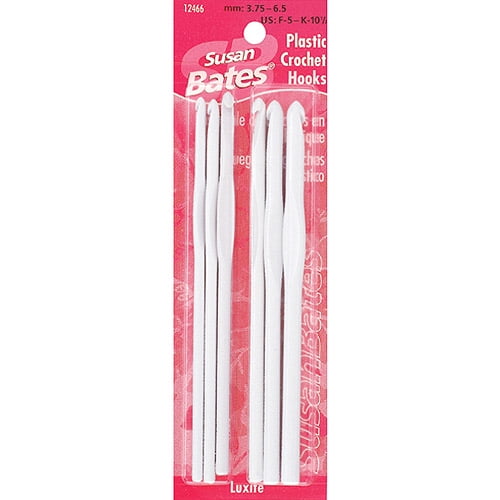
If you’re on a budget and love the minimal look, Susan Bates’ Luxite hooks are for you. You won’t find any bells and whistles here. Just a sturdy, smooth, all-white plastic hook. The size is etched into the side so it’s easy to identify, and the inline style mimics SB’s Silvalume’s without the heft. Though some sizes are pretty strong, I’ve broken several Luxites in the smaller sizes. You may have to sacrifice speed when working with these hooks if you have tight tension.
Notable benefits: very affordable, easily accessible, lightweight
6 // Best Ergonomic Hooks – Furls Wooden Streamlines
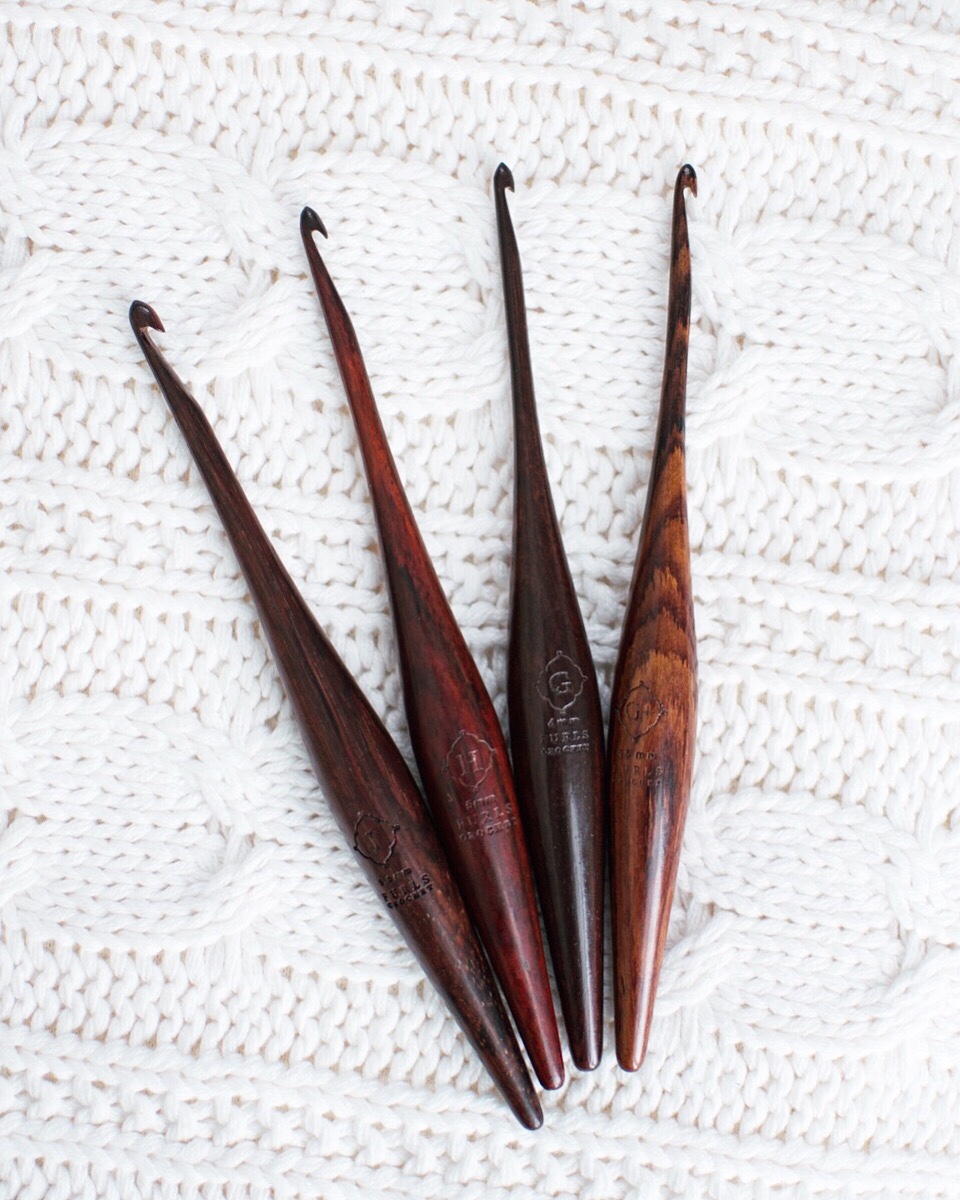
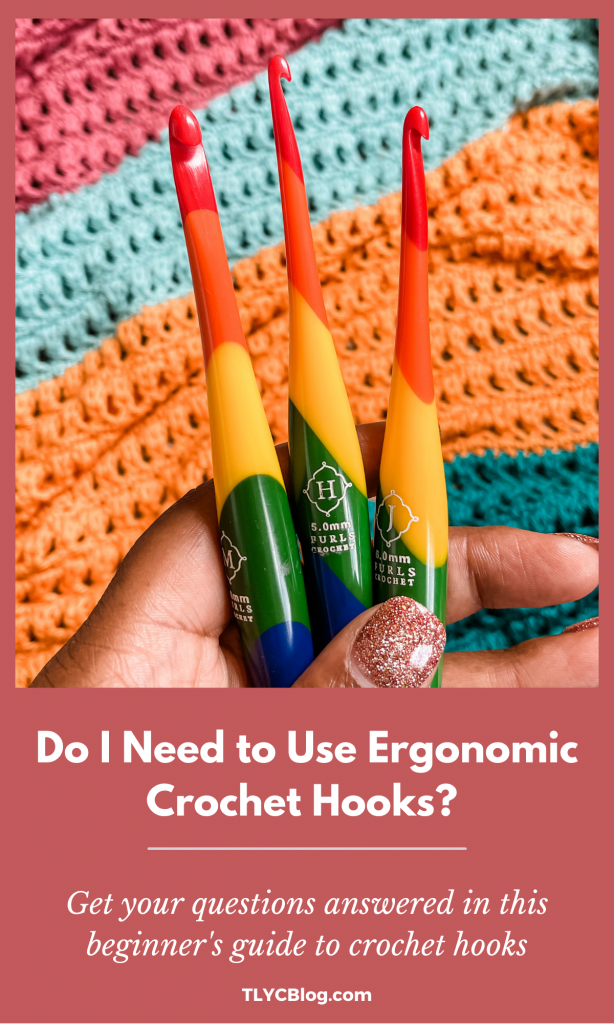
To be honest, Clover Amour would be my first choice for the best ergonomic hooks, but, since they’re already mentioned, we’ll give this category to Furls Wooden Streamlines. Furls’ claim to fame is their unique hook design, which addresses common crochet problems. They feature a hybrid hook head with a teardrop-shaped handle designed to nestle in the palm of your hand (though that doesn’t benefit those using a pencil grip). I chose the wooden Streamlines specifically because they are lightweight and inexpensive compared to the other hooks offered by Furls.
Notable benefits: lightweight, wise investment if these hooks work for you, designed with hand health in mind
7 // Best Jumbo Hooks – Clover Amour Large Hooks

Not like you can’t tell or anything, but I am a big Clover hook fan. Their large hooks are sold separately and in bundles, and they are a great choice for jumbo hooks. They even offer a 7mm size, which is especially tricky to find in the U.S. You’ll notice that the jumbo hooks are shaped like the smaller hooks and have the same rubber handle, but their body is made from lightweight, sturdy plastic. You won’t have to worry about these hooks breaking on you.
Notable benefits: sold individually so you can get only the sizes you need, offers 7mm hook size, colorful handles make finding the right size easy
8 // Best Crochet Thread Hooks – Clover Amour Steel Hook

Clover really covered all of their bases when it came to creating the ideal crochet hook collection. The steel hooks are made for working with crochet thread, a 100% cotton yarn that is incredibly thin. The steel hooks come with individual sheaths to protect the delicate hook heads. The handles are a muted pastel rainbow to further drive the point home that these are dainty hooks. While the hooks themselves are small, they are incredibly strong, with a steel hook nestled into the rubber handle.
Notable benefits: color-coded handles, rubber grip for comfortable crocheting, one set includes all the sizes you need for tiny crochet stitches
9 // Best Indie Hooks – Letto Workshop

Some of the best crochet hooks I’ve used can’t be found in stores. They’re made and sold by small, independent business owners. Letto Workshop is based in Ukraine and run by some of the sweetest people I know – Stan and Julie. Their signature ornate hooks are perfectly sized, even for my large hands. But they don’t stop at just one style. Stan and Julie have perfected multiple hook handle styles, some resulting in a 100% hand-carved wood hook and others with metal hook inserts. They range in price, starting at just $19, proving that you don’t have to break the bank to support small businesses.
Other notable indie hook makers: CroChic Styles, Ophire Co., Pink Sheep Design, and KnitBrook’s Hook BBs
10 // Best Beginner Hooks – WeCrochet’s Dots Hooks

Beginner crochet hooks should be comfortable, easy to use, and most of all, affordable. A new kid on the crochet block is the Dots Crochet Hook Set from WeCrochet. The set includes 9 colorful hooks ranging in size from 2.0mm to 6.0mm. The handle is a hard plastic with a rubberized coating making up the colorful portion. The rectangular thumbrest, mm size markings, and hope at the bottom (to hold stitch markers) are all nice touches, but the $24.99 price tag is what made my jaw drop. These hooks are high quality from a trusted company.
Notable benefits: color-coded handles in an adorable design, 6.5″ hook for those that need a longer tool, embossed sizes on the handle to prevent them from wearing away
What Should I Know About Crochet Hooks?
Just like learning about yarn, learning about crochet hooks and which works best for you is a journey. Thankfully, there are some universal features of crochet hooks that you can start to gravitate toward when building your crochet hook collection.
Crochet Hook Anatomy
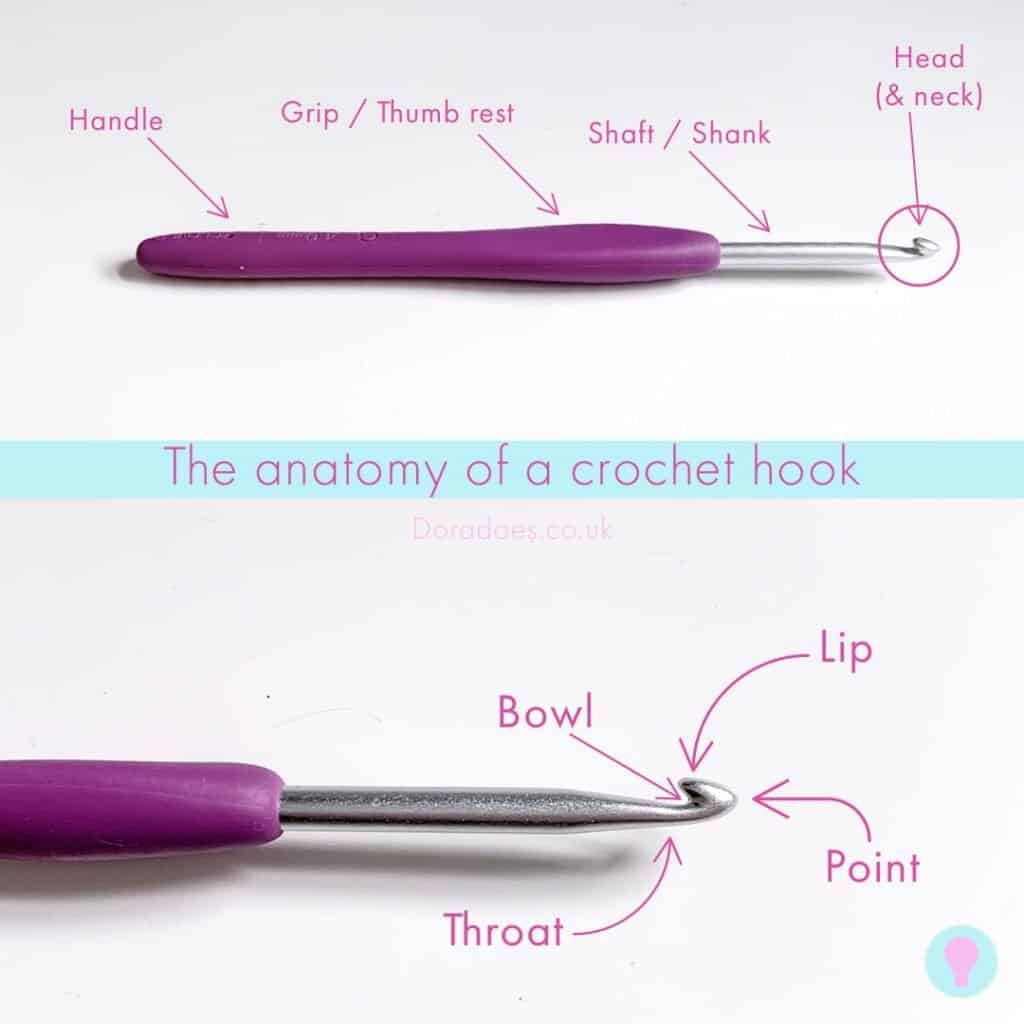
Every hook, from traditional to ergonomic and novelty, will feature these characteristics. Combining those characteristics and your unique crochet style will influence your preferred hook type.
- Head – The hook head includes the throat (the backside of the hook leading to the tip), the point (the top-most tip of the hook), the lip (the lower point of the head that hovers over the bowl), and the bowl (the hollow created by the lip, allowing the yarn to be caught by the hook). The hook head is the first point of contact you have with your stitches when crocheting. Common issues result from the tip being too sharp or too dull/rounded, or the bowl being too shallow/deep.
- Shaft/ Shank – this part of the hook leads to the body and is just above the thumb rest (if a thumbrest is present).
- Grip/ Thumbrest – this is a portion of the hook designed for your thumb to rest comfortably. This area varies in shape and width depending on the hook. Using the thumb rest can take your hand closer or further from the hook head, thus altering your crocheting style.
- Handle – this is the remainder of the hook past the thumb rest. This part of the hook nestles into your hand when crocheting with the knife hold, or hovers over your hand when crocheting with the pencil hold.
Inline Vs. Tapered Vs. Hybrid
While all hooks have the same anatomy, the slight differences in that anatomy put them into 1 of 3 categories: inline, tapered, or hybrid. Being in a particular category doesn’t make one hook better than the other – it all comes down to preference and which hook style fits the way you move.
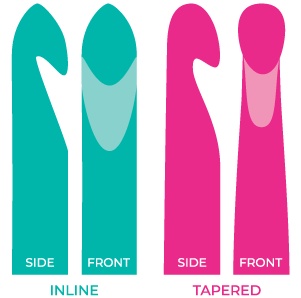
The differences between inline, tapered, and hybrid all come down to the relation between the hook head and the shaft:
- Inline: all features of the hook head are in line with the shaft from the shank to the point.
- Tapered: the throat tapers down as you reach the hook head, and the lip extends beyond the shank.
- Hybrid: some unique combination of the two styles.
Image source: WeCrochet
Pro Tip: If you’re trying to decide if you’re an inline (Team Bates) or tapered (Team Boye) person, get one of each hook from your local craft store and practice on a swatch of double crochet. The difference will likely be very obvious once you get going.
Crochet Hook Grip
Crochet hook grips are as unique as their users. How you hold your hook to compensate for your crochet style has many nuances. As you continue to practice crochet, experiment with the different grips or move your fingers onto different places in the hook to see what hold works best for you.
In general, most crocheters fall into 1 of two camps:
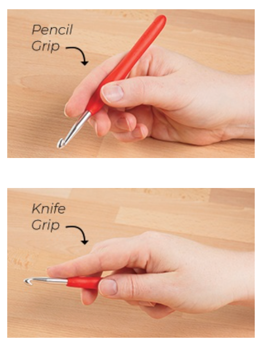
- Pencil Grip: the hook is held like a pencil with the handle floating above your hand.
- Knife Grip: the hook is held like a knife with the handle nestled in your palm.
Image source: WeCrochet
Crochet Hook Types
The craft of crochet has a lot of different applications, from amigurumi (doll and toy making) to broomstick lace, Tunisian crochet, and many more. Different types of crochet require different crochet hooks. Here are a few types of hooks you’ll see around the crochet aisle.
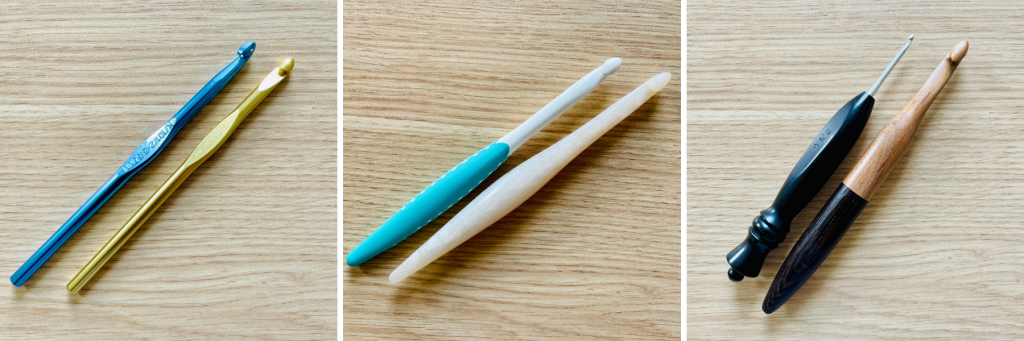
- Traditional (left): these hooks typically have no adornments or special styling on the handle. Both Boye and Susan Bates make a hook like this. Benefits: inexpensive and easy to find. Disadvantages: taxing on the wrist and hands, the finish will wear off with time and use.
- Ergonomic (middle): ergonomic hooks have some sort of adornment in the handle meant to alleviate the pain and stress that crochet can cause. This can be a softer material in the handle, a different handle shape, or some combination of these features. Benefits: focus on hand health, adds to the beauty and unique look of hook. Disadvantages: pricier than traditional hooks, might take costly trial and error to see if an ergonomic style actually works for you.
- Hand carved (right): more and more independent crochet hook makers are entering the scene and offering hand-carved wood-handled hooks. These hooks typically begin as a long block of wood and are whittled with hand tools or a lathe into a finished shape. Benefits: unique hooks, allows you to support a small business. Disadvantages: can be fragile, costs significantly more than traditional hooks.
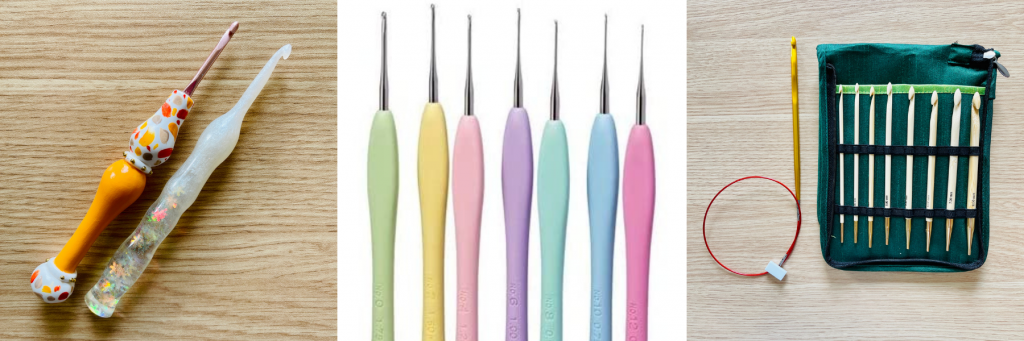
- Novelty (left): handmade hooks aren’t just for woodcarvers. Makers are getting creative with designing crochet hooks, adding polymer clay to the handles, or fashioning the whole hook from resin and glitter. A quick search on Etsy will pull up many small businesses doing fun things with crochet hooks. Benefits: one-of-a-kind hooks for your collection, a special find for a gift or holiday. Disadvantages: quality varies significantly from shop to shop, hooks can be fragile.
- Steel: (middle) steel hooks are the go-to tool for crocheting with very fine lace yarn. Often called crochet yarn, fine cotton yarn was historically used to make knock-off lace. In more recent history, such fine yarn and steel hooks were used to crochet heirloom home goods and garments. Presently, steel hooks are still used for intricate lace patterns, but more ambitious crocheters are venturing into mini amigurumi and intricate crochet portraits.
- Tunisian crochet hooks (right): Tunisian crochet is a hybrid craft that livesat the intersection of knitting and crochet. Loops are collected onto the hook for the forward pass and worked off of the hook for the return pass. The resulting fabric is dense with a unique look to either knitting or crochet stitches. Benefits: can also be used as traditional crochet hooks and are more accessible as popularity increases. Disadvantages: often sold in sets which can be expensive, these hooks rarely have thumb rests.
Crochet Hook Materials
Crochet hook materials are about more than aesthetics. Different materials apply more or less tension to your work while you’re crocheting. Consider these points when purchasing your next crochet hook.
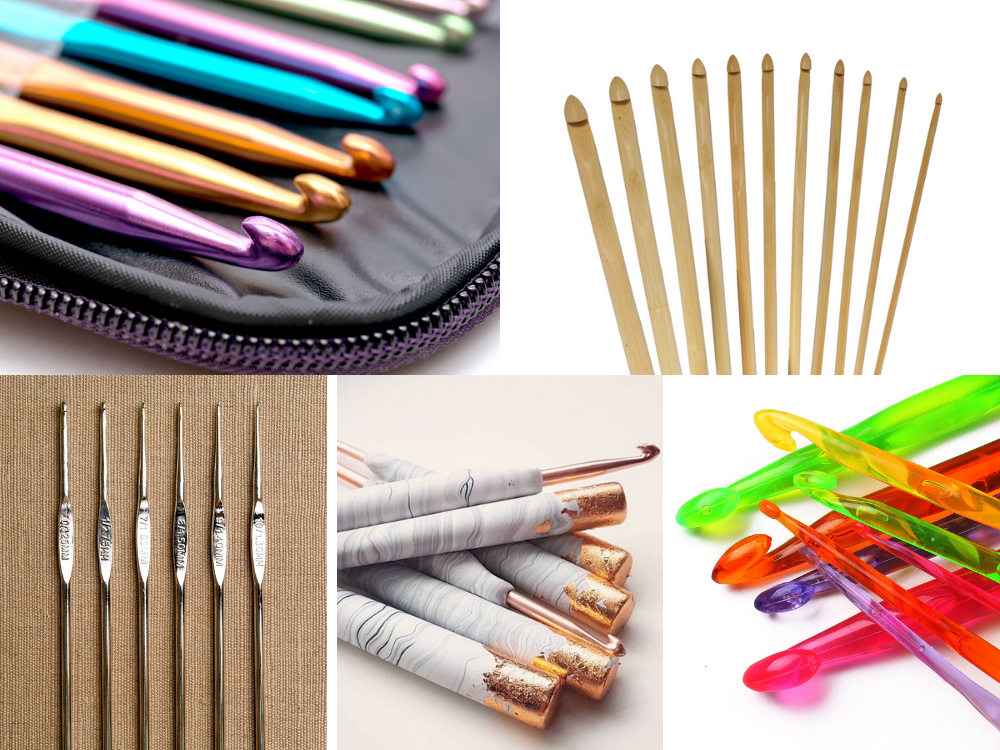
// Aluminum hooks are the most common and can be found in most big box stores. They come in various sizes and typically have a smooth finish from the tip to the handle. Because of their smooth finish and low friction, aluminum hooks are a good choice for high-tension yarns like animal and synthetic fibers.
// Wooden crochet hooks are typically made of wood like bamboo, pressed wood, or even sticks from trees. Wood hooks have a natural warmth to them and are sturdier than they look. High-quality wood hooks have a smooth exterior and work well with low-tension yarns like those found in plant fibers. The grain in the wood slows the slippery yarn from moving up and down the hook too fast. High-quality, smooth wood hooks are a great choice for crocheting with just about any type of yarn.
// Plastic hooks come in all shapes and sizes, and their crochet experience can vary greatly. While plastic hooks are easily accessible and inexpensive, they tend to bend and/or break. Look for sturdy plastic hooks like the ones made from resin sold by Furls and Prym. A common phenomenon in crocheting is plastic-on-plastic vibration. The motion of acrylic yarn on plastic hooks can emit a barely perceptible vibration that makes itself known through joint pain anywhere between your hands and shoulders. If you experience pain while crocheting, try switching to an aluminum or wood hook.
// Polymer clay-wrapped hooks are usually metal hooks with polymer clay decoratively wrapped around the handle. Clay is a beautiful medium for adding your personal flair to crochet hooks. Search for polymer clay hooks online or make your own with a tutorial (like this!).
// Steel crochet hooks are made of steel (obvs, lol). Since the hooks are so small, the weight of the steel doesn’t become a factor. Instead, steel’s strength and resistance mean these hooks will last forever.
Crochet Hook Sizes
Crochet Hook Conversion Chart
| UK | Metric | US | Recommended Yarn Weight (yarn category) |
| 14 | 2.00mm | 0 | Lace (0) |
| 13 | 2.25mm | B/1 | Lace to Superfine (O-1) |
| 12 | 2.5mm | C/2 | Superfine (1) |
| 11 | 3.00mm | – | Superfine (1) |
| 10 | 3.25mm | D/3 | Superfine (1) |
| 9 | 3.5mm | E/4 | Superfine to Fine (1-2) |
| – | 3.75mm | F/5 | Superfine to Fine (1-2) |
| 8 | 4.00mm | G/6 | Fine (2) |
| 7 | 4.5mm | 7 | Fine to Light (2-3) |
| 6 | 5.00mm | H/8 | Light (3) |
| 5 | 5.5mm | I/9 | Light to Medium (3-4) |
| 4 | 6.00mm | J/10 | Medium (4) |
| 3 | 6.5mm | K/10.5 | Medium to Bulky (4-5) |
| 2 | 7.00mm | 10.75 | Bulky (5) |
| 0 | 8.00mm | L/11 | Bulky (5) |
| 00 | 9.00mm | M/13 | Bulky to super bulky (5 to 6) |
| 000 | 10.00mm | N/15 | Super bulky (6) |
Crochet hook sizes are represented in numbers, letters, and metric measurements depending on your preference and where you live. Use this chart if you’re ever confused when reading patterns from a different country or when buying crochet hooks online.
Hook size recommendations are subjective. It depends on the type of fabric you’re trying to create. The recommendations in this chart assume you want to achieve a medium tension using basic stitches. Know that using a larger hook than recommended will give you a looser fabric, and a smaller hook will give you a tighter fabric.
When working from a pattern, try the recommended hook first. If you’re not working from a pattern, try the hook recommended in the chart above and adjust your hook up or down to get the drape and tension you’re looking for.
Learn More!
Curious about some of the specialty hooks on the market? Check out my video reviews of hooks from Furls, Amazon, and Bella Coco.
Crochet Hook Q&A
What are the best crochet hooks?
In my opinion, the best crochet hooks are Clover Amour. They come in every size from teeny steel hooks to jumbo Q hooks and everything in between. They’re easily accessible and can often be found on sale. They have a hybrid hook head, making them good for those who prefer inline and those who go for tapered hooks. Investing in a good set of crochet hooks early will prevent hours of frustration down the line. Wait until there is a craft store coupon to potentially get the full set for 50% off.
What is the best crochet hook size for beginners?
The best crochet hook size for beginners is anything from 5.0mm to 6.0mm. This size hook works well for a 4 – medium/worsted or 5 – bulky weight yarn. This combination of yarn and hook size means it will be easy to see your stitches and insert your hook into the right place.
Are inexpensive crochet hooks worth it?
Learning how to crochet with inexpensive, often inferior crochet hooks is unnecessary. Cheap crochet hooks sets on Amazon and elsewhere typically have an uneven finish and vary widely in craftsmanship. To avoid the frustration of bad tools, get your hooks using the links in this post or drop into a big box or local craft store.
What is the most comfortable crochet hook?
Ergonomic crochet hooks are designed with hand health in mind. They typically have some kind of cushion or design in the handle that makes them easier to use for longer periods of time. Purchase a single ergonomic hook of your choice to give it a try before investing in a whole set.
Do ergonomic crochet hooks help?
Absolutely, yes! Not all ergonomic crochet hooks are created equal. But high-quality ergonomic hooks like Clover Amour, Furls Streamline, and Prym crochet hooks all aid in the comfort of crocheters. You’ll notice a major difference if you’re a marathon crocheter (someone who crochets for hours or days on end).
Are Furls crochet hooks worth it?
Are you trying to start a war out here?! lol Crocheters are fiercely loyal about their Furls crochet hooks, but, as with all things craft, it comes down to preference. Furls offers several different types of hooks made of different materials and shapes. Those differences make them a great fit for some and an awful fit for others. I recommend waiting for a sale and getting your preferred hook types in your most used size to try them.
Are metal, wood, or plastic crochet hooks better?
Of all the hooks available, the current consensus is that metal hooks, especially aluminum, are superior, followed closely by wood with plastic trailing behind. But this is not a hard and fast rule. I’m a big fan of CroChic Styles resin hooks, but I have difficulty using Furls Odyssey aluminum hooks. It’s all a matter of preference – try them all and see what you like personally.


