

Crochet Gauge: What Is It And Why It Matters

Have you ever found the perfect crochet pattern, started making, and realized that it was turning out much too large or much too small? Or maybe you bought the exact yarn you needed for a project and ran out before you had a chance to finish. You, my dear, have an issue with gauge, and I’m here to fix it. This quick and dirty guide will give you a better understanding of gauge, how to measure it, and how to adjust it for perfect crochet projects every time.
This post contains affiliate links that support the content on TLYCBlog.com. All opinions are my own. Find my Privacy & Disclosures Policy here.

CLICK TO PIN THIS POST
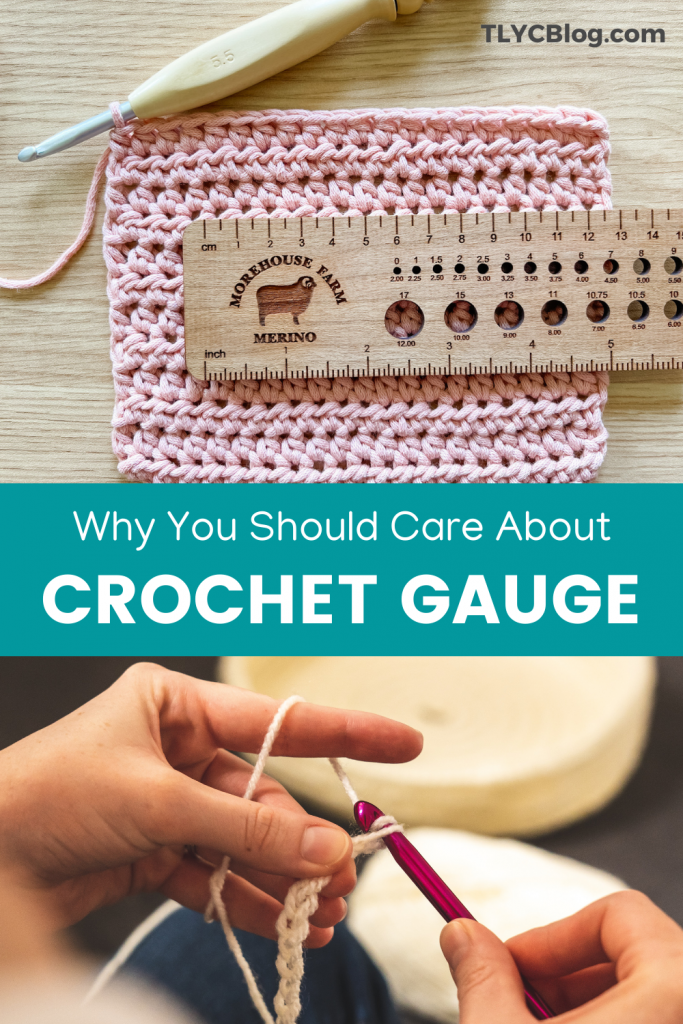
What is Crochet Gauge?
In short, crochet gauge is the number of stitches and rows within a measurement of crochet fabric. If you and I sat down side by side with the same hook, yarn, and pattern, likely, our finished project would still have some differences in size. That is because our tension is different, which impacts our gauge within a pattern. Nuanced differences in how we create our stitches, hold our yarn, and work our magic make each crocheter’s tension wholly unique.
Why Does Gauge Matter to Crocheters?
Differences in tension can cause small variances that are negligible in most crochet projects. For example, you might not be motivated to test your gauge for a blanket because you won’t mind if it comes out a little larger or smaller than the designer intended.
But you might be more apt to test your gauge if you were making a sweater, top, or other wearable garments and accessories. For items like this, size absolutely matters.
Crochet patterns include gauge to encourage you to replicate the designer’s original stitches. This ensures your project comes out the intended size, using the intended amount of yarn. While being a couple stitches off in a gauge swatch might seem like no big deal, imagine that difference being multiplied over thousands of stitches. And, all of a sudden, you have a tunic when you planned to crochet a crop top.
How Do I Measure Crochet Gauge?
Gauge is written in crochet patterns as a certain number of stitches and rows for a measurement. The standard gauge measurement is 4″ x 4″, but that may change from pattern to pattern. To measure the gauge, make a gauge swatch (also called a tension square) using the recommended hook size and your chosen yarn. Try this for example:
Gauge: 4″ = 13 hdc x 10 rows with 5.5mm hook.
If the above were stated in a pattern, a 4″ square of half double crochet stitches worked with a 5.5mm crochet hook would be 13 stitches wide and 10 rows high. To make your gauge swatch, start with a chain just a bit more than recommended in the swatch. This swatch recommends 13 hdc for 4″, so I will start with a chain of 18, hdc in the 2nd chain from the hook and each chain across for a total of 17 hdc. I would then crochet to 12 rows, just a bit more than recommended in the gauge swatch.
Pro Tip: Make your gauge swatch a few stitches and rows larger than instructed in the pattern. You might be wondering – Toni, why would I make my gauge swatch bigger than the pattern recommends?! Gauge in edge stitches is inconsistent. We have a tendency to hold our stitches looser (or, sometimes, tighter) on the ends. Stitches in the center of the crochet fabric are more indicative of true tension.
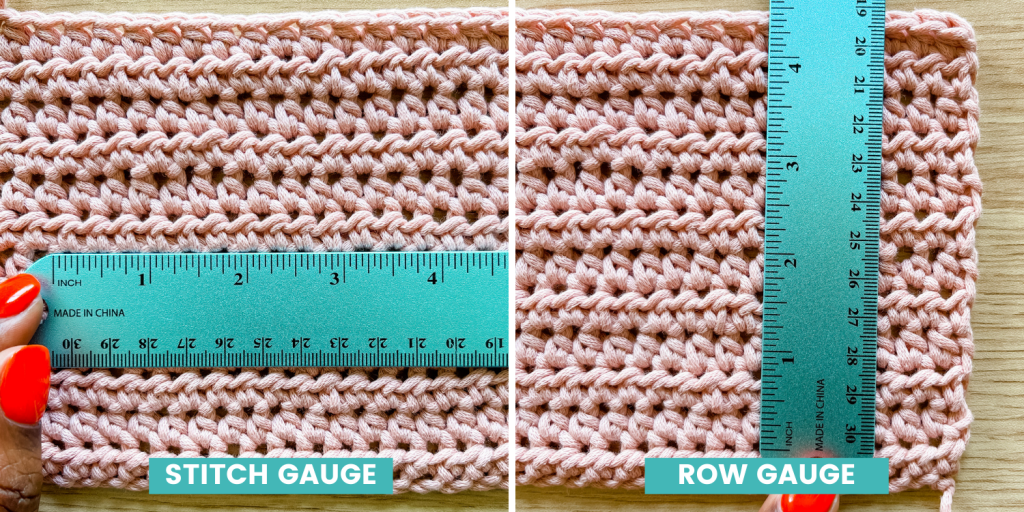
Using a rigid ruler or a gauge ruler, measure the number of stitches and rows within gauge size. For our example, I was able to make gauge perfectly in the photos above. On the left, you can see that I’ve measured my stitches along the bottom v’s, and I have 13 hdc stitches within 4 inches. On the right, I’ve measured 10 total rows for 4″. Let me be clear: it is improbable that you will hit gauge on the first try. That’s where adjusting comes in.
How Do I Adjust My Crochet Gauge?
If gauge is important in the pattern you are working on, take the time to adjust your gauge as needed. Anytime you make adjustments, make a new swatch and measure it again.
// Adjusting Crochet Stitch Count
- Too Many Stitches. If you find that you have too many stitches in your row, it’s time to adjust your hook. Too many stitches means you need to have looser tension, so go up a hook size, or switch to a hook material that has less drag. Start by going up in 0.5mm increments if there is only a small difference. If you are using a wood or plastic hook, switch to metal.
- Too Few Stitches. If you find that you have too few stitches in your row, it is also time to adjust your hook. Too few stitches means you need to have tighter tension, so go down a hook size, or switch to a hook material that has more drag. Start by going down in 0.5mm increments if there is only a small difference. If you are using a metal hook, switch to plastic or wood.
// Adjusting Crochet Row Count
In some circumstances, row gauge is an easy fix – just add more or less rows onto your project. But, if a pattern or design has specific row repeats or you have concerns about running out of yarn, it pays to get the correct tension. Row gauge comes down to The Golden Loop, or the loop closest to your hook on the last step of your stitch. How tight (or loose) that loop is dictates the height of your rows. Learn more about the Golden Loop in THIS VIDEO.
- Too Few Rows. This means that you are a “lifter”, or that you lift the loop on your hook before yarning over to complete the stitch. This elongates your stitches, making your stitches taller than that of the designer. Try tightening down on your loop before completing your stitches.
- Too Many Rows. This means that you are a “yanker”, or that you yank down on the working yarn before yarning over to finish your stitch, thus creating a shorter stitch than that of the designer. Try loosening up on your working yarn before completing your stitches.
What Else Can Impact Crochet Gauge?
You might not realize it, but there are plenty of factors that play into your crochet gauge. Here’s a list of a few ways your crochet habits impact your gauge:
- Yarn Choice: Not all yarns within the same yarn weight are created equal. Do a gauge swatch whenever you plan to substitute yarns in a pattern.
- Holding the Working Yarn: Loosen or tighten your hold on the working yarn to adjust your tension. I like to loop the yarn over my finger twice for slippery yarns and just once for grippy yarns.
- Hook Brand: Hooks made from the same material but across brands can impact gauge. Aluminum hooks, for example, can be smooth or rough, and they can be shiny or matte. Each difference impacts the drag of the yarn over the hook, thus changing your gauge. I’m able to get consistent gauge with THESE HOOKS every time!
- Hook Size: If you keep the yarn consistent, changing hook size will loosen or tighten your gauge. Adjust your hook size to achieive the drape you are looking for in your crochet fabric.
- Hook Hold: Pencil-holders are more likely to be yankers while knife-holders are more likely to be lifters. Keep an eye on your Golden Loop and play around with your hook hold to reach the gauge you need.
- Hook Material: On the spectrum of grippy to slippery, wood hooks are the grippiest, then comes plastic hooks and finally metal hooks. This is all subjective and I recommend having each type of hook on hand and swapping them out when needed. Learn even more about crochet hooks in THIS POST.
- Maker Temperment: You might not want to hear this, but your mood can impact your tension. If you are having a good day, you’ll likely maintain smooth tension throughout the project. But, if you are stressed, have bad posture, are distracted, or any combination of not-quite-yourself, it may come out in your tension. Avoid these tension issues by resetting your frame of mind before crocheting. Also, try new stitches and techniques on a practice swatch so you won’t get frustrated with your main project.


