

Yarn Substitutions Made Easy

Need to substitute the yarn used in a crochet or knitting pattern for something else? Yarn substitutions can be confusing for beginning crocheters, but this guide offers a quick and easy way to find the perfect swap for your next project!
This post contains affiliate links that support the content on TLYCBlog.com. All opinions are my own. Find my Privacy & Disclosures Policy here.

Pin This Post – Share The Love!

What Are Yarn Substitutions?
If you are diving into a new pattern or project, but you can’t or don’t want to use the yarn recommended, you’ll need to make a substitution. Here on my blog, I’ve shared my strategy for yarn substitutions in a post about yarn weights and one about reading yarn labels. It’s such an important topic that I decided to give it its own post so you can reference it whenever necessary.
There are many reasons to swap out the original yarn in a pattern. Here are just a few:
- You are allergic to the fiber within the original yarn
- The original yarn is low stock or discontinued
- You are looking for an alternative yarn that is easier to care for than the original yarn
- You don’t have access to the original yarn
- You have yarn in your stash that you’d like to use instead of the original yarn
Regardless of your reason, finding a suitable yarn substitution shouldn’t be so difficult when starting a new crochet project. Try my simple method and see if it works for you.
What Should I Consider When Doing Yarn Substitutions?
Looking to get creative with your yarn choice? There are four main components in the decision to substitute one yarn for another. Swapping out yarns will change the weight, drape, care, and look of a project. Whether you want to mimic or completely modify the original design, consider these four components that Tayler of Wool Needles Hands on YouTube highlights:
- FIBER // Fibers perform differently, both within and between categories. Cellulose (plant), protein (animal), and acrylic fibers all have different characteristics when stitched. If you want to mimic the original design, use a yarn sub with fiber content as close to the original as possible.
- COLOR // Does the original pattern use a solid yarn, and you’re going with self-striping? Or maybe the original uses a color-blocked stripe pattern with tonal yarn, and you want to go with a zany speckled option. Adjusting the colors used will modify the overall aesthetic. It helps to make a swatch, which will give you an idea of how color will lay in your project.
- TEXTURE // With so many yarn options on the market, the texture of the yarn you’re swapping in becomes a major consideration. Worsted spun, woolen spun, thick-thin, boucle, mohair, chainette, and so on. Each option looks and performs differently in stitched fabric and will change the final mood and feel (touch) of the piece.
- DENSITY // This refers to how heavy a yarn is by weight. Fibers like silk and cotton, for example, are heavier by weight than wool or angora. Increasing or decreasing the density of the yarn compared to what was originally in the pattern will impact how much yarn you need, how heavy the final piece is, and what kind of drape it has. My simple yarn substitution method (explained below!) helps you achieve a density similar to the original pattern.
Watch Tayler’s video for a breakdown of what to consider in a yarn sub:
Yarn Substitutions, Simplified
When substituting yarns in a pattern, you are looking to match not only the size of the finished piece but often the texture and drape of the finished fabric. The most accurate way to substitute yarn in a pattern is to get a skein of the potential substitute and make a gauge swatch to compare to the gauge in the pattern. But this can be a lengthy and costly experiment. Thankfully, I have a simple method for finding a reasonable yarn substitute for crochet projects without spending lots of time and money upfront. Here’s how to do it!
Step 1: Get the Specs from the Original yarn
Find the yardage and fiber content from the original yarn. You can often find the fiber content and yardage of the original yarn on the label, in the pattern itself, or from a quick Google search.
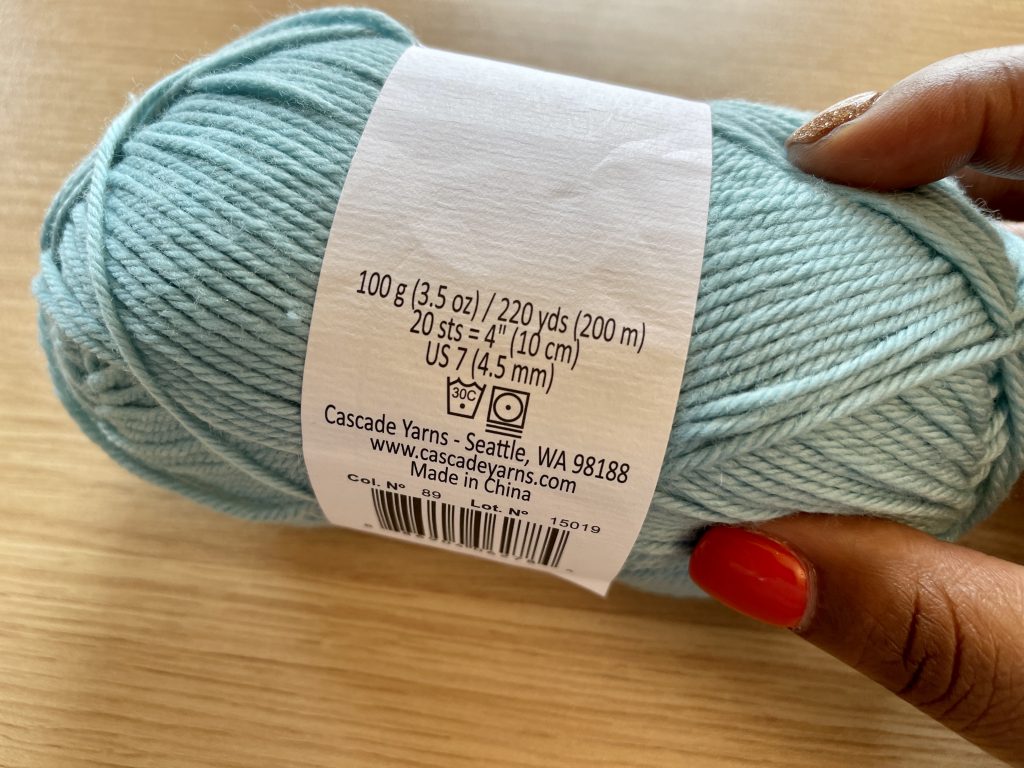
For this example, let’s say the original yarn is Cascade 220 Superwash, which is a 100% superwash merino wool. This ball has 220 yards per 100 grams.
Step 2: Find a Yarn with Similar Specs
Search for yarns that come close to the original fiber content and yardage. Finding a yarn with similar yardage is the main priority. Similar yardage suggests you’ll achieve a similar gauge and be close to the total yardage used. I try to stay within a +/-20% range with matching yardage. Matching the fiber content ensures the texture and drape of the final piece will be similar, but you can go off-script here.
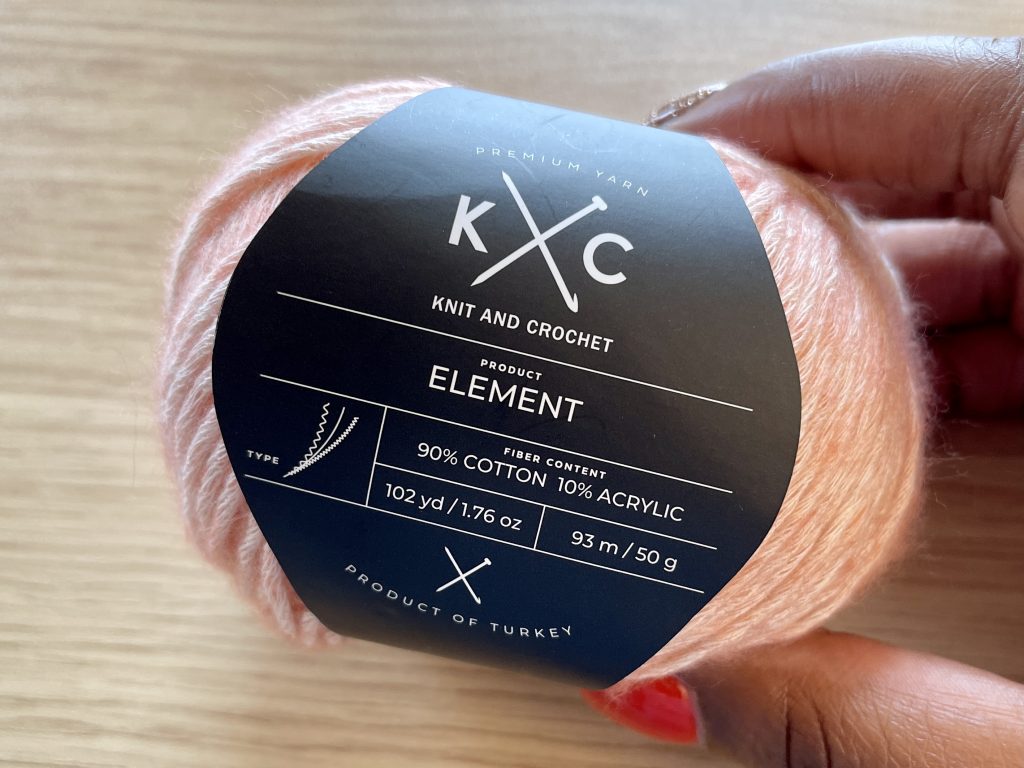
The yarn I am considering as a substitute is a yarn from my stash called K+C Element, a cotton and acrylic blend with 204 yards per 100 grams. My +/-20% margin of yardage is 44 yards (Cascade 220 has 220 yards; 20% of 220 = 44 yards). 204 yards per 100 grams falls within my 20% margin, so this yarn is a good choice in terms of yardage. I know from the label that my substitute has a different fiber content so the fabric may perform differently, but that is ok for me in this case, as my first priority is using yarn from my stash. Curious about yarn fibers? Discover 11 popular fibers in this post.
Step 3: Figure Out How Much Yarn You Need
Calculate how much of the substitute yarn is needed to complete the pattern. Now that we’ve found a suitable substitute, we’ll need to figure out how much of the new yarn we need to complete our pattern. If you have a pattern, it should list the exact yardage used. Try your best to match that yardage and pick up 1 extra ball of your substitute yarn just to be safe.
If your pattern does not list yardage and says something like “4 skeins Cascade 220 Superwash”, start by calculating that amount. 220 yards per skein x 4 skeins = 880 total yards. 880 yards / 102 yards per 50g ball of K+C Element = 8.62 skeins, which we’ll round up to 9 skeins. I’d purchase 10, again, just to be safe.
Holding Yarn Double
With the rise in popularity of yarn being held double in knitting and crochet patterns, you might be curious about how to use this strategy in your projects. Unfortunately, there is conflicting information about what weight holding two identical yarns together will produce. Some resources suggest that two identical weights held double will produce the next weight (for example – two strands of fingering make sport), while others suggest a heavier weight (for example – two strands of fingering make DK).
I’ve found the most accurate way to determine the gauge of a yarn held double is to calculate the new yardage. Let’s say I have a fingering weight yarn with 400 yards per 100 grams. If I held this yarn double, I would divide the yardage in half to get my new weight. 400 / 2 = 200 yards per 100 grams. This new weight falls in the worsted category – I can now use this information to determine if holding a yarn double will be a suitable substitution in my pattern. Read this blog post by Math for Knitters for a deeper dive on holding yarns together.
Plan B: YarnSub.com
When all else fails and you can’t seem to find a reasonable sub for your yarn, try YarnSub.com. YarnSub is a database of over 10,000 yarns that tracks the features of yarns to suggest reasonable substitutes with the click of a mouse.

Suggestions on YarnSub.com are rated as an excellent match or a good match, and a comparison of the two yarns is listed so you can make an informed decision. Visit YarnSub.com and test the different yarns you typically use to see what substitutes are suggested. NOTE: Yarn Sub does not list every commercially available yarn, but it’s a great place to start. YarnSub.com also hosts a great collection of articles and recent books to browse.


